 listicle
Space Saving Drawer Dividers for Kitchens: 2026 Guide
Table of Contents
- How to Measure Kitchen Drawers Before You Buy Drawer Dividers
- Adjustable Kitchen Drawer Dividers: Top Picks Compared
- Bamboo vs. Plastic Drawer Dividers: Which Holds Up Better?
- How to Organize Kitchen Drawers for a Clutter-Free Workflow
- DIY Kitchen Drawer Dividers: Budget-Friendly Options That Work
- Weight Capacity, Durability, and Eco-Friendly Considerations
- Conclusion
Last Updated: August 11, 2026
Kitchen drawers become chaotic quickly, and drawer dividers are one of the simplest fixes available, yet most people buy the wrong size or skip measuring altogether. This guide walks you through exactly how to measure and compares the best adjustable options so you can make a confident purchase.
Quick Picks:
- Best Overall: SpaceAid Bamboo Drawer Organizer with Inserts - maximum customization with 9 inserts included
- Best Budget-Friendly Bamboo: Bambusi Adjustable Bamboo Drawer Dividers (6-Pack) - simple, tool-free, and versatile
- Best for Flatware: OXO Good Grips Expandable Utensil Drawer Organizer - non-slip feet and removable trays
- Best Premium/Built-In Look: Rev-A-Shelf Wood Cutlery Tray Insert - trimmable maple hardwood for a permanent fit
How to Measure Kitchen Drawers Before You Buy Drawer Dividers
Accurate measurements are the single step most buyers skip, and it's why many dividers end up returned or unused. Grab a tape measure and record three dimensions.
Width is the interior measurement from side wall to side wall. Most spring-loaded bamboo dividers span 17 to 22 inches, covering standard kitchen drawers.
Depth is the front-to-back measurement. This matters when using perpendicular inserts to create a grid layout. An 18-inch-deep drawer needs inserts cut to match, or you'll have dead space at the back.
Height is the interior wall height. Bamboo dividers typically stand 2.5 to 2.6 inches tall. If your drawer is shallower, the divider won't sit flat; if much deeper, items will spill over.
| Measurement | Where to Measure | Why It Matters |
|---|---|---|
| Width | Interior side wall to side wall | Determines expandable range needed |
| Depth | Front wall to back wall | Governs insert length |
| Height | Drawer floor to top of drawer side | Confirms divider height will fit |
| Drawer depth (for stacking) | Floor to drawer opening | Needed for stackable or double-layer systems |
Write your numbers down before opening a product page. Drawer dimensions are rarely what you assume, especially in older kitchens.
Adjustable Kitchen Drawer Dividers: Top Picks Compared
Expandable drawer dividers adapt to different widths without cutting or drilling. The four picks below cover budget bamboo to premium hardwood.
1. Bambusi Adjustable Bamboo Drawer Dividers (6-Pack)
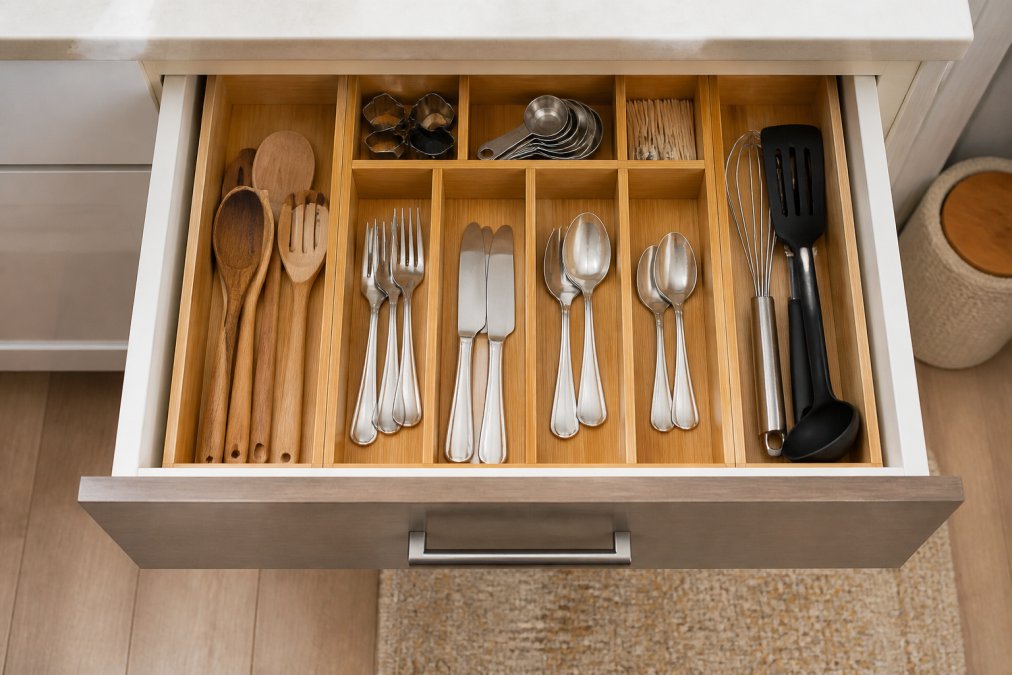
The Bambusi 6-pack is the easiest entry point into bamboo organization. Each divider expands from 17.5 to 22 inches, fitting most standard kitchen drawer widths. Spring-loaded ends grip interior walls without tools, and the 2.6-inch height keeps most utensils contained.
Six dividers give you enough to section two full drawers or create a generous grid in one deep drawer. The bamboo surface is smooth and scratch-resistant.
Limitation: No cross-inserts included, so you're limited to parallel lanes. Smaller items like teaspoons need separate inserts.
Best for: Anyone starting a kitchen organization overhaul who wants a natural, tool-free solution.
Pros:
- Tool-free spring-loaded installation
- 100% natural bamboo, eco-friendly and durable
- Versatile across multiple rooms
Cons:
- No sub-compartment inserts included
- May not suit very deep drawers
2. SpaceAid Bamboo Drawer Organizer with Inserts
SpaceAid is ideal for fully customizable layouts. The set includes 4 expandable dividers spanning 17 to 22 inches, plus 9 cross-inserts that slot perpendicularly to create smaller compartments. This turns a single drawer into a modular grid you can reconfigure as needs change.
The inserts are the standout feature. Dedicated slots for pastry brushes, peelers, and ladles make compartmentalization genuinely useful. Spring-load installation is tool-free and fast.
Limitation: Nine inserts mean more configuration pieces and trial-and-error spacing. Inserts may not accommodate very wide or oddly shaped tools.
Best for: Users needing highly customizable organization with varied compartment sizes.
Pros:
- 9 inserts allow true modular, custom-fit layouts
- Spring-load design, no tools required
- Natural bamboo construction
Cons:
- More pieces to configure
- Inserts may not accommodate oversized tools
3. OXO Good Grips Expandable Utensil Drawer Organizer
OXO's expandable tray takes a different approach with pre-designed compartments that expand to fit different widths. Non-slip feet keep it stationary, and square corners eliminate wasted space.
This suits flatware and standard utensils well. Compartments are sized for forks, knives, spoons, and serving pieces. Removable trays make cleaning straightforward.
Tradeoff: Fixed compartments limit flexibility for odd-shaped tools. Plastic construction isn't preferred by eco-conscious buyers.
Best for: Organizing flatware and standard utensils in dedicated drawers.
Pros:
- Non-slip feet ensure stability
- Square corners maximize interior space
- Removable trays for easy cleaning
Cons:
- Fixed compartments limit adaptability
- Plastic construction
4. Rev-A-Shelf Wood Cutlery Tray Insert (4WCT Series)
Rev-A-Shelf offers a permanent solution that looks built-in. Maple hardwood trays drop into the drawer and can be trimmed to exact dimensions. The UV-cured finish protects the wood and wipes clean easily.
This is the premium tier. According to Rev-A-Shelf's product specifications, the 4WCT series is available in two sizes, with the larger option measuring approximately 33 inches wide by 22 inches deep, suitable for wide kitchen drawers.
Best for: Homeowners seeking a permanent, high-quality organizer that integrates with kitchen cabinetry.
Pros:
- Trimmable to exact drawer dimensions
- Durable maple hardwood with protective finish
- Drop-in installation, no hardware required
Cons:
- Trimming requires tools and effort
- Significantly higher price point
Bamboo vs. Plastic Drawer Dividers: Which Holds Up Better?
Bamboo wins on durability and aesthetics; plastic wins on price and washability.
Bamboo is genuinely dense and scratch-resistant when processed correctly. Quality bamboo dividers won't warp under normal kitchen conditions and don't absorb food odors. As noted by the USDA Forest Service on bamboo as a sustainable material, bamboo can be harvested in three to five years compared to decades for most hardwoods, making it a meaningfully better choice for eco-conscious buyers.
Plastic dividers are cheaper and fully waterproof, wiping clean in seconds. The downside is longevity: budget plastic organizers crack, warp under heat, and look worn within a year or two.
Weight capacity matters too. Bamboo dividers holding heavy cast iron utensils flex less than thin plastic trays. The spring-loaded tension design distributes load across drawer walls rather than concentrating it on the divider itself.
How to Organize Kitchen Drawers for a Clutter-Free Workflow
Drawer organization works best when it mirrors how you actually cook. The most common mistake is organizing by category without thinking about which items you reach for simultaneously during meal prep.
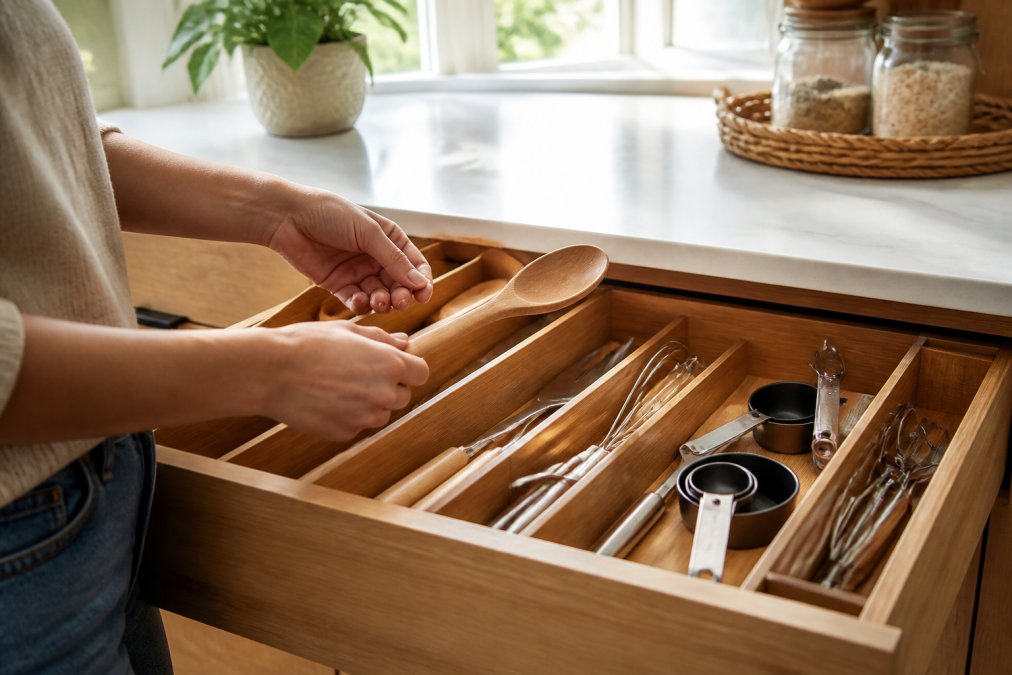
Start with a simple audit: pull everything out, discard duplicates and broken items, and group what remains by frequency of use. Daily items belong in the most accessible drawer closest to your prep area.
Organizing Utensils, Cutlery, and Odd-Shaped Tools
Standard cutlery organizers handle forks, knives, and spoons well. The challenge is odd-shaped tools: citrus zesters, pastry brushes, meat thermometers, garlic presses. These make most systems fail within weeks.
The solution is dedicated small compartments rather than a single "miscellaneous" zone. With modular inserts, you can create a narrow slot for flat tools like peelers, a square compartment for bulky items like a garlic press, and a longer lane for ladles. When every tool has a specific home, returning it becomes automatic.
A practical layout for a standard drawer:
- Lane 1 (front, narrow): Cutlery and small tools used daily
- Lane 2 (middle): Cooking utensils and measuring spoons
- Lane 3 (back): Less-used or longer tools like tongs and ladles
Accessibility-Focused Drawer Layouts
Standard organization assumes users can see into the drawer, reach across it, and handle small items with fine motor precision. The Americans with Disabilities Act guidance on accessible kitchen design provides a framework for reach zones and clearance.
Practically, this means:
- Place most-used items in the front third of the drawer
- Use taller dividers for easier gripping
- Avoid small compartments requiring pinching
- Choose non-slip drawer liners to prevent tray shifting
Ergonomic organization benefits everyone, making daily kitchen workflow faster and less frustrating.
DIY Kitchen Drawer Dividers: Budget-Friendly Options That Work
Not every drawer needs a commercial organizer. For shallow junk drawers or temporary setups, DIY solutions work well.
Tension rod dividers are underrated. Standard spring-tension curtain rods placed vertically create instant lanes for files, cutting boards, or baking sheets. They're adjustable, removable, and cost almost nothing.
Repurposed small boxes create compartments inside larger trays. Shallow cardboard boxes or wooden crates cut to height can be arranged to create custom sections for irregular items.
Foam pipe insulation cut to drawer depth creates soft dividers that won't scratch interiors and can be cut to any height.
The honest limitation is longevity and aesthetics. Cardboard compresses and absorbs moisture. Tension rods can slip if drawer sides aren't parallel. For heavy daily use, quality bamboo or hardwood systems outlast improvised fixes by years.
For a polished DIY approach, services like Drawer Insert Designer's custom wood organizer service allow you to design fully custom solid wood inserts to exact dimensions in walnut, white oak, maple, or cedar.
Weight Capacity, Durability, and Eco-Friendly Considerations
Most divider listings don't publish explicit weight ratings. Here's what governs capacity.
Spring-loaded bamboo dividers transfer load to drawer walls through tension. The divider itself bears little direct weight, making them suitable for most kitchen contents, including moderately heavy items.
Fixed tray inserts like Rev-A-Shelf maple trays sit on the drawer floor and distribute weight across their full footprint. Hardwood trays handle heavier loads more reliably than plastic and won't flex under a full silverware set.
Plastic organizers are weakest for heavy loads. Thin plastic trays crack at stress points when carrying dense items.
On eco-friendliness, bamboo is the standout. It's biodegradable, grows without pesticides, and produces durable products without off-gassing chemicals. When bamboo organizers reach end-of-life, they can be composted rather than sent to landfill.
| Divider Type | Relative Durability | Eco Profile | Best Load Type | Price Range |
|---|---|---|---|---|
| Bamboo spring-loaded | High | Excellent | Moderate weight, varied items | Mid-range |
| Hardwood tray insert | Very high | Good | Heavy cutlery, permanent use | Premium |
| Plastic expandable | Moderate | Poor | Lightweight utensils | Budget |
| DIY tension rod | Low | Excellent | Lightweight, flat items | Minimal cost |
The Reset Aisle's approach to home organization is built around solutions that hold up in real households. The same thinking applies when choosing drawer dividers: buy for durability first, aesthetics second.
The right drawer divider system eliminates daily frustration and makes meal prep genuinely faster. For most households, a bamboo expandable system like SpaceAid or Bambusi handles the majority of kitchen drawers without cutting or drilling. For a permanent, premium finish, the Rev-A-Shelf hardwood insert is worth the investment. Start with accurate measurements, match the divider to your actual contents, and the organization sticks.
Frequently Asked Questions
Are bamboo or plastic drawer dividers better for kitchens?
Bamboo dividers are more durable over time, resist moisture better than cheap plastic, and won't warp or crack under normal kitchen conditions. They also look cleaner in open or frequently accessed drawers. Plastic expandable organizers cost less upfront and work fine for lighter loads, but high-quality bamboo holds up better in busy households and is the more eco-friendly choice for long-term use.
How do you measure a drawer for custom dividers?
Measure the interior width, depth, and height of your drawer, not the exterior. Use a tape measure and record in inches. Most adjustable drawer dividers fit widths between 17 and 22 inches, so confirm your interior width falls in that range. Also measure drawer depth to check that dividers won't block the drawer from closing. Write down all three numbers before ordering any insert or divider set.
What are the best dividers for kitchen drawers?
Spring-loaded bamboo dividers like the Bambusi 6-Pack or SpaceAid set work well for most standard kitchen drawers because they install without tools and stay firmly in place. For cutlery specifically, the Rev-A-Shelf wood tray insert gives a built-in look and trims to fit exactly. If you need a utensil tray that expands to match your drawer width, the OXO Good Grips organizer is a practical plastic option with non-slip feet.
How do you make DIY kitchen drawer dividers?
The simplest DIY approach uses foam board or thin plywood cut to your drawer's interior height and depth. Score and snap foam board to width, then wedge pieces between drawer walls to create compartments. For a more finished look, cut thin wood strips and use wood glue or small finishing nails to build a custom grid. Tension rods from a dollar store also work as instant, no-cut dividers for separating baking sheets or cutting boards stored vertically.
Can drawer dividers hold heavy kitchen tools without slipping?
Spring-loaded and tension-mounted dividers hold securely against drawer walls and handle the weight of most kitchen tools without slipping. Bamboo models like the Bambusi and SpaceAid sets use spring pressure rather than adhesive, so they stay put even when you drop heavy items in. For very heavy loads, a drop-in wood tray insert like the Rev-A-Shelf option provides the most structural stability since it sits flat on the drawer base.
Cluttered kitchen drawers are a daily friction point that a well-chosen organizer solves permanently. The Reset Aisle curates practical, space-saving storage solutions designed to bring calm and order to every room, including the drawers that see the most daily use. Browse the full collection at The Reset Aisle and Start Your Reset with storage that works for your real kitchen, not an idealized one.
This article was written using GrandRanker
Frequently Asked Questions
Are bamboo or plastic drawer dividers better for kitchens?
Bamboo dividers are more durable over time, resist moisture better than cheap plastic, and won't warp or crack under normal kitchen conditions. They also look cleaner in open or frequently accessed drawers. Plastic expandable organizers cost less upfront and work fine for lighter loads, but high-quality bamboo holds up better in busy households and is the more eco-friendly choice for long-term use.
How do you measure a drawer for custom dividers?
Measure the interior width, depth, and height of your drawer, not the exterior. Use a tape measure and record in inches. Most adjustable drawer dividers fit widths between 17 and 22 inches, so confirm your interior width falls in that range. Also measure drawer depth to check that dividers won't block the drawer from closing. Write down all three numbers before ordering any insert or divider set.
What are the best dividers for kitchen drawers?
Spring-loaded bamboo dividers like the Bambusi 6-Pack or SpaceAid set work well for most standard kitchen drawers because they install without tools and stay firmly in place. For cutlery specifically, the Rev-A-Shelf wood tray insert gives a built-in look and trims to fit exactly. If you need a utensil tray that expands to match your drawer width, the OXO Good Grips organizer is a practical plastic option with non-slip feet.
How do you make DIY kitchen drawer dividers?
The simplest DIY approach uses foam board or thin plywood cut to your drawer's interior height and depth. Score and snap foam board to width, then wedge pieces between drawer walls to create compartments. For a more finished look, cut thin wood strips and use wood glue or small finishing nails to build a custom grid. Tension rods from a dollar store also work as instant, no-cut dividers for separating baking sheets or cutting boards stored vertically.
Can drawer dividers hold heavy kitchen tools without slipping?
Spring-loaded and tension-mounted dividers hold securely against drawer walls and handle the weight of most kitchen tools without slipping. Bamboo models like the Bambusi and SpaceAid sets use spring pressure rather than adhesive, so they stay put even when you drop heavy items in. For very heavy loads, a drop-in wood tray insert like the Rev-A-Shelf option provides the most structural stability since it sits flat on the drawer base.