 listicle
Durable Storage Bins for Kids: 2026 Buyer's Guide
Table of Contents
- What Makes Storage Bins for Kids Truly Durable
- Heavy Duty Toy Storage Bins: Top Picks Compared
- Toy Storage Ideas for Toddlers That Actually Work
- How to Organize Kids' Toys for Long-Term Success
- Sustainability, Toxicity, and Long-Term Durability Testing
- Integrating Storage Bins with Your Existing Furniture
- Cleaning and Maintenance by Material Type
- Which Storage Bin Type Is Right for Your Home?
Last Updated: August 11, 2026
Choosing the right durable storage bins for kids sounds straightforward until you're standing in a pile of scattered LEGOs at 7 a.m. wondering why the bins you bought six months ago are already cracking. This guide cuts through that frustration by focusing on what actually holds up, the materials, the safety features, and the organizational strategies that stick long-term.
What Makes Storage Bins for Kids Truly Durable
Durability in kids' storage comes down to three things: material integrity, construction quality, and whether the design accounts for how children actually use things. Kids don't gently place items in bins. They dump, drag, sit on, and occasionally throw them.
Material Breakdown: Plastic, Wood, Canvas, and Fabric
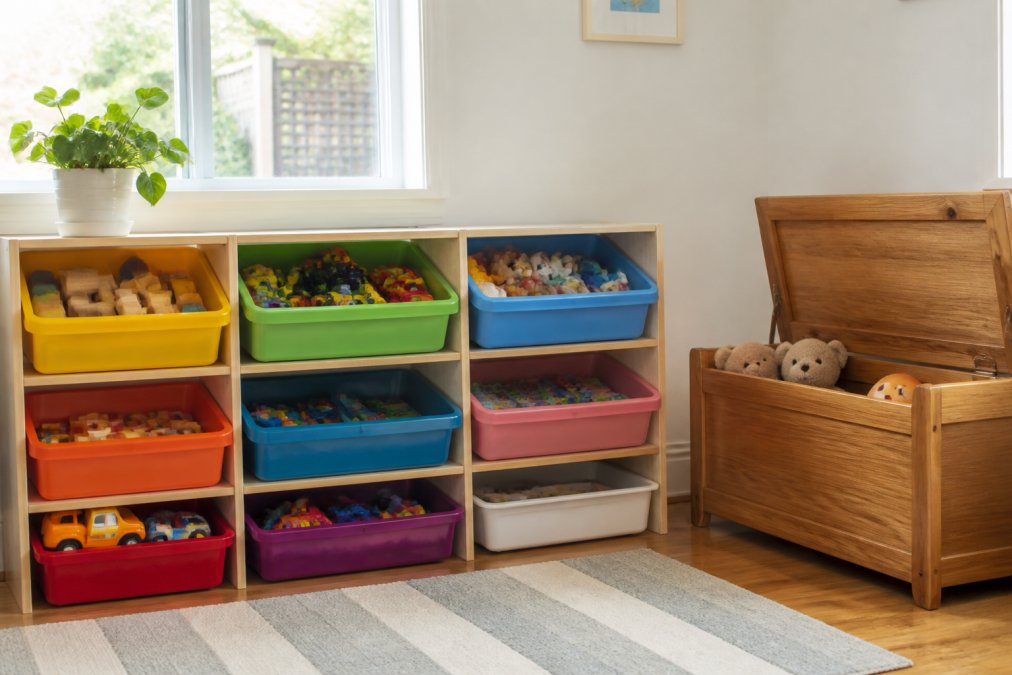
Plastic is the most impact-resistant option for everyday playroom use. High-density polyethylene and polypropylene bins resist cracking under lateral stress and are easy to wipe clean.
Wood offers the best long-term structural integrity. Solid hardwood toy boxes, like those from Weaver Furniture Sales, are built from maple with slow-closing lid mechanisms and can outlast childhood entirely.
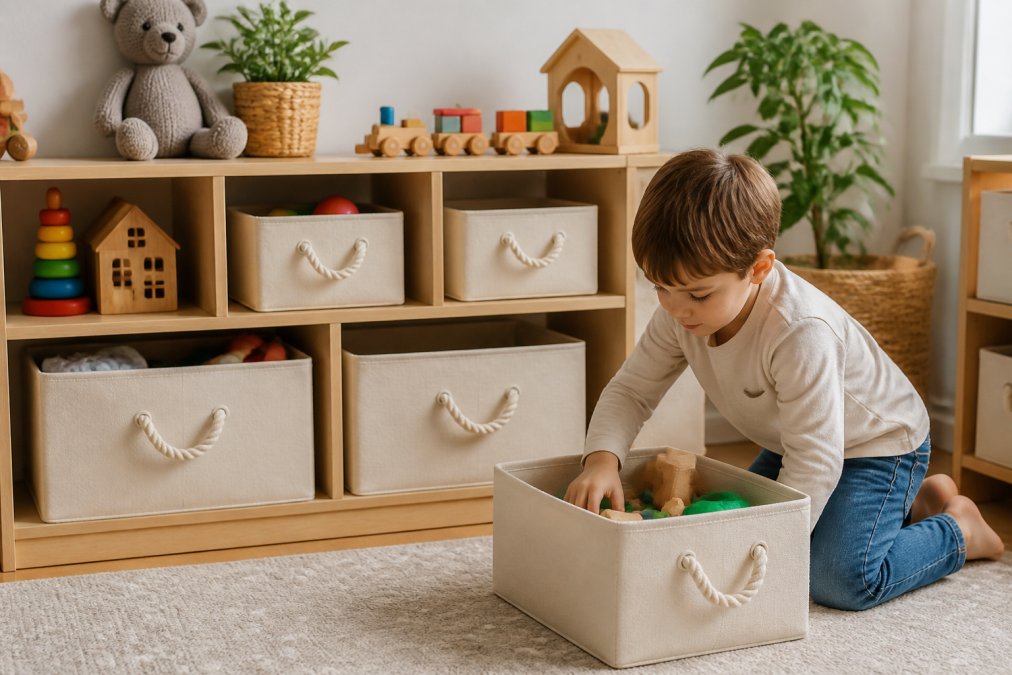
Canvas and fabric bins are toddler-friendly with no sharp edges or pinch points. Look for reinforced seams and a sturdy interior frame rather than fully floppy construction.
Woven and engineered wood frames sit between plastic and solid wood, lighter than hardwood but less impact-resistant than molded plastic.
Safety Features That Matter: BPA-Free, Rounded Corners, and Locking Lids
BPA-free is the baseline for any plastic bin in a child's space. The U.S. Consumer Product Safety Commission guidelines on children's products outline material safety standards that reputable manufacturers follow.
Rounded corners matter most for toddlers and crawlers. Canvas and fabric bins eliminate this risk entirely. Plastic bins vary, check the corner radius before buying.
Safety-hinged lids are critical for any lidded box. Both the Melissa & Doug Wooden Toy Chest and the Step2 Lift & Hide Toy Box include safety-hinge mechanisms that prevent the lid from dropping freely.
Heavy Duty Toy Storage Bins: Top Picks Compared
| Product | Material | Best For | Key Safety Feature | Durability Level |
|---|---|---|---|---|
| Step2 Lift & Hide Toy Box | Heavy-duty plastic | Toddlers, rough use | Safety-hinged lid | Very High |
| Melissa & Doug Wooden Toy Chest | Solid wood | Long-term / heirloom | Safety-hinged lid | Exceptional |
| Greenmade 27-Gallon Clear Bin | Clear plastic | Seasonal rotation, garage | Stackable, locking lid | High |
| Humble Crew Multi-Bin Organizer | Engineered wood + fabric | Playroom organization | Open design, no lid hazard | Moderate-High |
| Your Zone Collapsible Fabric Bin | Fabric | Cubby systems, light use | No sharp edges | Moderate |
| Pehr Canvas Storage Containers | Canvas | Nurseries, light toys | Soft construction | Moderate |
| Weaver Furniture Custom Wood Box | Solid hardwood | Heirloom investment | Slow-closing lid | Exceptional |
Plastic Bins: Impact-Resistant and Easy to Wipe Clean
The Step2 Lift & Hide Toy Box handles the physical abuse that cracks thinner alternatives, and the exterior wipes clean with a damp cloth. The safety-hinged lid is a genuine differentiator.
The Greenmade 27-Gallon Clear Storage Bins serve bulk storage and seasonal toy rotation. Their stackable design maximizes vertical space, and the clear construction lets you identify contents without opening every bin. These aren't playroom-floor bins, they're organizational infrastructure for managing what's in rotation versus what's stored away.
Wooden Toy Boxes: Heirloom-Grade Construction
A solid hardwood toy chest from Weaver Furniture Sales, built from maple with customizable finish and personalization options, is a piece of furniture that will outlast every plastic bin on this list by decades. The Melissa & Doug Wooden Toy Chest offers a more accessible entry point with 8.25 cubic feet of storage, multiple finish options, and a safety-hinged lid.
Canvas and Fabric Bins: Washable and Toddler-Friendly
Canvas and fabric bins are ideal for nurseries, toddler rooms, and cubby organizer systems. Pehr Canvas Storage Containers fit standard cube bookcases with soft construction and no pinch points. The Your Zone Collapsible Fabric Bin is the budget-friendly version.
Fabric bins aren't built for heavy loads. Overloading causes the sides to bow and the base to sag. Use them for lighter items, stuffed animals, dress-up accessories, board books, and reserve heavier bins for blocks, vehicles, and construction toys.
Toy Storage Ideas for Toddlers That Actually Work
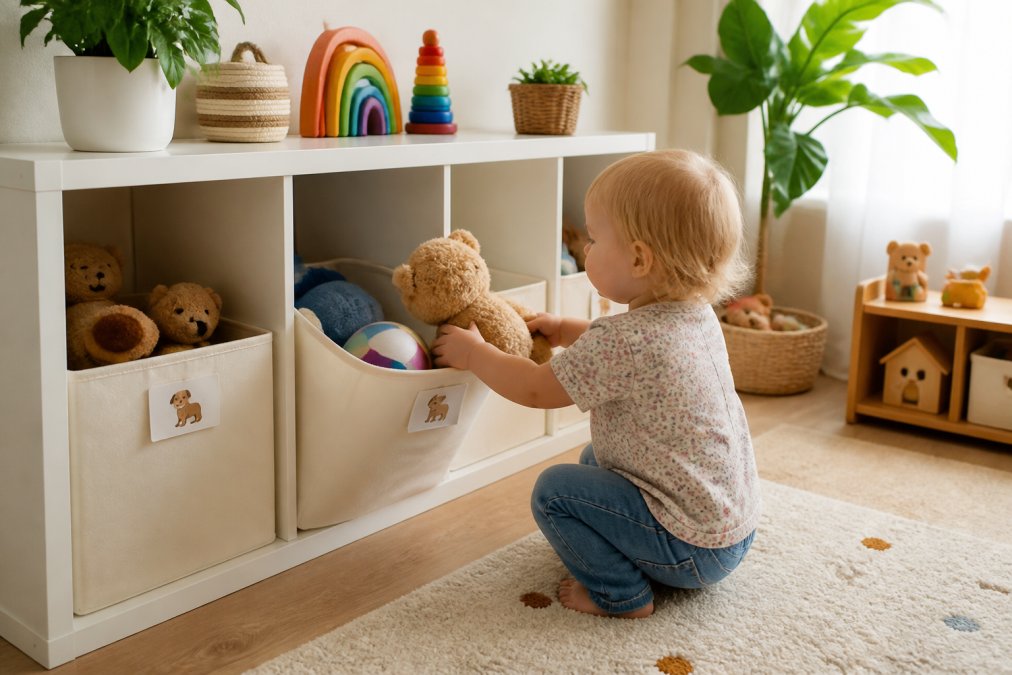
Toddler-friendly storage has one rule: if a child can't access it independently, it won't be used for cleanup. The best systems are built around low placement, open fronts, and visual cues.
Low-Profile Cubby Bins and Open-Front Designs
Open-front cubby systems, like the Humble Crew Toy Storage Organizer, are the gold standard for toddler-accessible organization. Bins slide out easily, toys are visible without digging, and children can return items without adult help. Keep the lowest cubbies for the most frequently used toys and reserve higher cubbies for items requiring adult involvement.
Under-Bed Storage and Vertical Space Solutions
Clear totes with locking lids work well under beds. The Greenmade bins are deep enough to hold bulky items and stack flat under most standard bed frames. Label the end facing outward so contents are identifiable without pulling the bin fully out.
Vertical space solutions, wall-mounted shelves, over-door organizers, tall cubby units, are particularly valuable in small rooms. The American Academy of Pediatrics safe room guidelines recommend securing all tall furniture to walls to prevent tip-over hazards.
How to Organize Kids' Toys for Long-Term Success
The biggest reason organization systems fail isn't the products. It's the absence of a maintenance strategy.
Toy Rotation Strategies That Reduce Clutter
Toy rotation is the single most effective clutter management strategy for families with young children. Keep a fraction of toys accessible at any time and store the rest, rotating every two to four weeks. Fewer toys in circulation means less daily clutter, and rotated toys feel new again when reintroduced.
A working rotation system involves three to four labeled bins in storage and one active set in the playroom. Keep storage bins in a space accessible to adults but not children, so the "new" toys retain their novelty.
Labeling Systems and Age-Appropriate Organization
Labeling systems need to match the child's developmental stage. For pre-readers, picture labels work better than text. For early readers, simple one-word labels ("LEGO," "Cars," "Books") are more effective than descriptive phrases.
Young children can't manage fifteen distinct categories. Start with four to six broad groups (building, vehicles, stuffed animals, art, books, dress-up) and add specificity as children get older.
Sustainability, Toxicity, and Long-Term Durability Testing
BPA-free certification means a product doesn't contain bisphenol A, but other bisphenol compounds (BPS, BPF) can be present in some plastics. For families prioritizing minimal chemical exposure, solid hardwood, natural canvas, and certified non-toxic fabric bins are the most straightforward choices. The CPSC children's product safety resources provide guidance on what certifications to look for.
Long-term durability testing reveals that fabric bins with non-reinforced seams degrade significantly after repeated loading over twelve to eighteen months. Plastic bins develop stress fractures at hinge points. Solid hardwood and heavy-duty molded plastic consistently outperform in extended use.
Solid wood from responsibly managed forests is the most genuinely sustainable option. Canvas made from natural fibers is biodegradable; synthetic fabric bins are not.
Integrating Storage Bins with Your Existing Furniture
The most overlooked dimension of kids' storage buying decisions is furniture compatibility. A cubby bin system that doesn't fit your existing bookcase creates more problems than it solves.
Measure before buying. Standard cube organizers accept bins sized around 11 inches square, but tolerances vary by manufacturer. Consider how storage integrates with room function. A toy chest at the foot of a bed doubles as a bench. A low cubby system along one wall creates a room divider between play and sleep zones.
Before buying new storage, audit what you already have. A deep closet shelf with stackable clear bins often outperforms a dedicated toy organizer that consumes floor space. For small rooms with awkward dimensions, modular storage is more adaptable than fixed-frame systems.
Cleaning and Maintenance by Material Type
Storage bins for kids get dirty. Maintenance requirements vary significantly by material.
| Material | Cleaning Method | Frequency | Durability Under Cleaning |
|---|---|---|---|
| Heavy-duty plastic | Wipe with damp cloth, mild soap | As needed | Excellent |
| Solid wood | Dry wipe; occasional wood-safe cleaner | Monthly | Good (avoid saturation) |
| Canvas (natural fiber) | Spot clean or hand wash | Monthly or as needed | Good |
| Synthetic fabric | Spot clean; some machine washable | As needed | Moderate |
| Engineered wood frame | Wipe frame; remove bins for washing | Monthly | Moderate |
Plastic bins are the clear winner for low-maintenance households. For wooden boxes, avoid moisture saturation and use wood-safe cleaner rather than all-purpose sprays.
Canvas bins that are machine washable offer the best of both worlds: soft construction plus genuine cleanability. Fabric bins with interior cardboard stiffeners are problematic when wet, the cardboard warps and the bin loses its shape. Look for bins with plastic or wire interior frames if cleanability matters.
According to guidance from the American Cleaning Institute, fabric surfaces in children's spaces should be cleaned regularly to reduce allergen and bacteria buildup.
Which Storage Bin Type Is Right for Your Home?
The right storage bin depends on the child's age, the room's function, and your household's maintenance tolerance.
For toddlers (ages 1-3): Open-front cubby bins with canvas or fabric inserts. Low placement, no lids, soft materials, and no sharp edges.
For preschoolers (ages 3-5): A mix of open cubby bins for daily toys and a lidded plastic or wooden box for larger items.
For school-age children (ages 5+): More specific categorization becomes possible. Clear stackable bins for collections, canvas bins for soft items, and a wooden chest or heavy-duty plastic box for larger toys.
For playrooms that double as living spaces: Canvas bins, wooden boxes, and fabric-front cubby systems integrate better than utilitarian clear plastic totes.
For garages, basements, and seasonal storage: Heavy-duty plastic with locking lids and stackable design.
Most households need more than one type. A practical starting point: one open-front cubby system for daily access, one lidded box for larger items, and stackable clear bins for rotation storage.
Frequently Asked Questions
What are the best materials for durable kids' storage bins?
Heavy-duty plastic is the most impact-resistant option and wipes clean in seconds, making it ideal for high-traffic playrooms. Solid hardwood offers heirloom-grade durability but costs more. Canvas and washable fabric bins are soft and toddler-friendly, though they hold up less well under heavy or sharp objects. For most households, a mix of rigid plastic bins for heavy toys and fabric cubby bins for lighter items covers all the bases.
Are plastic or fabric bins better for kids' storage?
Plastic bins win on durability, hygiene, and clutter management. They resist stains, tolerate rough handling, and can hold heavier toys without losing shape. Fabric bins are lighter, quieter when dropped, and gentler for toddler-friendly spaces, but they can sag over time and most are not machine washable. The right choice depends on what goes inside: use plastic for building sets and heavy toys, fabric for stuffed animals and dress-up items.
What safety features should I look for in storage bins for kids?
Prioritize BPA-free or non-toxic materials certified to ASTM F963 (the U.S. toy safety standard). Look for rounded corners and shatter-resistant construction on plastic bins, and safety-hinged lids on toy chests that prevent sudden slamming. Bins with easy-carry handles reduce tipping risk. For toddlers, avoid locking lids that small fingers cannot open independently, and choose low-profile designs so kids can reach inside without climbing.
How do you keep kids' storage bins clean and sanitary?
Plastic and hard-sided bins wipe down with a damp cloth and mild soap. For deeper cleaning, a diluted white-vinegar solution removes odors without leaving chemical residue. Fabric bins with removable liners can often be machine washed on a gentle cycle; check the care label first. Canvas baskets benefit from spot-cleaning and air drying. Schedule a quick wipe-down of all bins monthly to stay ahead of grime, especially in high-use playrooms.
What is toy rotation and how does it reduce clutter?
Toy rotation means keeping only a portion of toys accessible at one time and storing the rest in labeled, stackable containers, typically clear totes or lidded bins. Every few weeks, swap out one set for another. Kids engage more deeply with fewer options, cleanup takes less time, and the playroom stays manageable. Clear bins make rotation easy because you can see exactly what is stored without opening every container. Large-capacity bins work well for seasonal or long-term storage.
Keeping a child's space genuinely organized requires storage that holds up to daily reality, not just the first week. The Reset Aisle curates home organization solutions focused on space-saving, clutter control, and making your existing space work more effectively. Whether you're setting up a playroom from scratch or finally tackling a room that's gotten out of hand, starting with the right storage foundation makes everything else easier. Start Your Reset with storage built to last.
This article was written using GrandRanker
Frequently Asked Questions
What are the best materials for durable kids' storage bins?
Heavy-duty plastic is the most impact-resistant option and wipes clean in seconds, making it ideal for high-traffic playrooms. Solid hardwood offers heirloom-grade durability but costs more. Canvas and washable fabric bins are soft and toddler-friendly, though they hold up less well under heavy or sharp objects. For most households, a mix of rigid plastic bins for heavy toys and fabric cubby bins for lighter items covers all the bases.
Are plastic or fabric bins better for kids' storage?
Plastic bins win on durability, hygiene, and clutter management. They resist stains, tolerate rough handling, and can hold heavier toys without losing shape. Fabric bins are lighter, quieter when dropped, and gentler for toddler-friendly spaces, but they can sag over time and most are not machine washable. The right choice depends on what goes inside: use plastic for building sets and heavy toys, fabric for stuffed animals and dress-up items.
What safety features should I look for in storage bins for kids?
Prioritize BPA-free or non-toxic materials certified to ASTM F963 (the U.S. toy safety standard). Look for rounded corners and shatter-resistant construction on plastic bins, and safety-hinged lids on toy chests that prevent sudden slamming. Bins with easy-carry handles reduce tipping risk. For toddlers, avoid locking lids that small fingers cannot open independently, and choose low-profile designs so kids can reach inside without climbing.
How do you keep kids' storage bins clean and sanitary?
Plastic and hard-sided bins wipe down with a damp cloth and mild soap. For deeper cleaning, a diluted white-vinegar solution removes odors without leaving chemical residue. Fabric bins with removable liners can often be machine washed on a gentle cycle; check the care label first. Canvas baskets benefit from spot-cleaning and air drying. Schedule a quick wipe-down of all bins monthly to stay ahead of grime, especially in high-use playrooms.
What is toy rotation and how does it reduce clutter?
Toy rotation means keeping only a portion of toys accessible at one time and storing the rest in labeled, stackable containers, typically clear totes or lidded bins. Every few weeks, swap out one set for another. Kids engage more deeply with fewer options, cleanup takes less time, and the playroom stays manageable. Clear bins make rotation easy because you can see exactly what is stored without opening every container. Large-capacity bins work well for seasonal or long-term storage.